Public AI product
MetaSculpt AI
I co-founded and shipped a public AI product spanning prompt tracking, citation capture, crawl analysis, weekly reports, and Schema JSON generation.

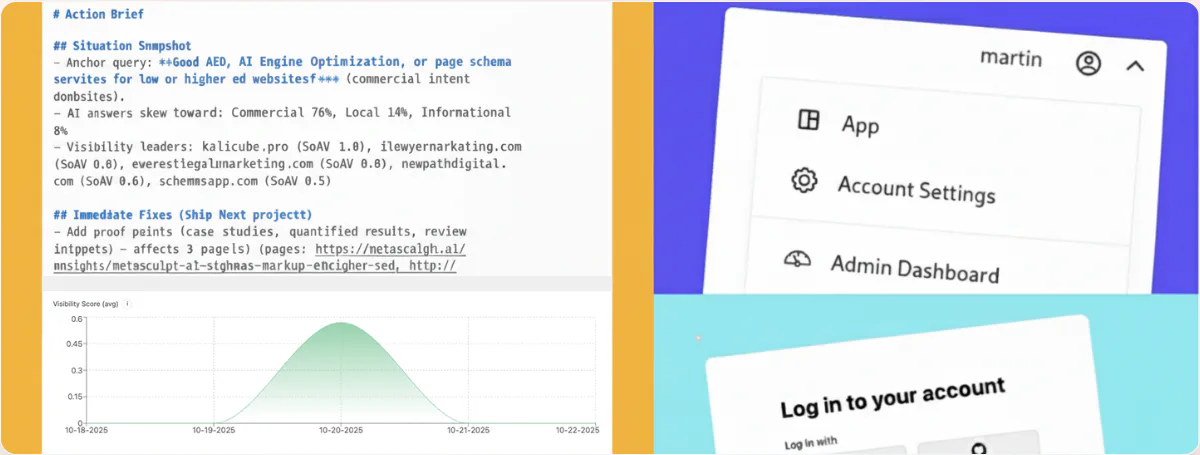
- Crawl
- Generate
- Validate
- Fix
Problem
What needed to change
People trying to compete in AI search needed a practical way to track visibility in AI-generated answers, understand which prompts mentioned them, compare competitor citations, and add useful Schema JSON to their sites.
Users
Who the system serves
Site owners, marketers, and AI-search visibility teams trying to understand why they appeared or failed to appear in GPT, Perplexity, Gemini, and other AI-answer surfaces.
Team context
Where I fit
Co-Founder (technical lead)
Two-person company. Product and technical decisions were shared with a co-founder; I owned AI workflow design, crawler and reporting logic, documentation, and code review.
Important technical decision
Separate collection from generation
I separated crawler and generator responsibilities and organized the product around a Crawl → Generate → Validate → Fix flow.
Tradeoff or limitation
Delivery without traction
A Wasp frontend template was the starting point. The product shipped publicly but did not gain user traction, so the verified result is delivery rather than adoption.
Implementation
What I personally owned
- Owned the AI workflow design, crawler logic, prompt tracking, experiment setup, weekly reporting, documentation, and code review with a co-founder.
- Used a Wasp frontend template as the starting point, then implemented the product workflow, data capture, report logic, and AI-search analysis around it.
- Shared product and technical decisions with the co-founder.
Result
Result and limitations
- Prompt and experiment tracking with competitor and citation capture.
- Crawler-backed site comparison and weekly insight reports.
- Schema JSON generation and validation.
- The complete workflow shipped publicly.
- The product did not ultimately gain user traction; the verified result is delivery, not adoption.
Technical scope